Automating Compliance in the CI/CD Pipeline: How DevSecOps Teams Accelerate Delivery Without Sacrificing Security
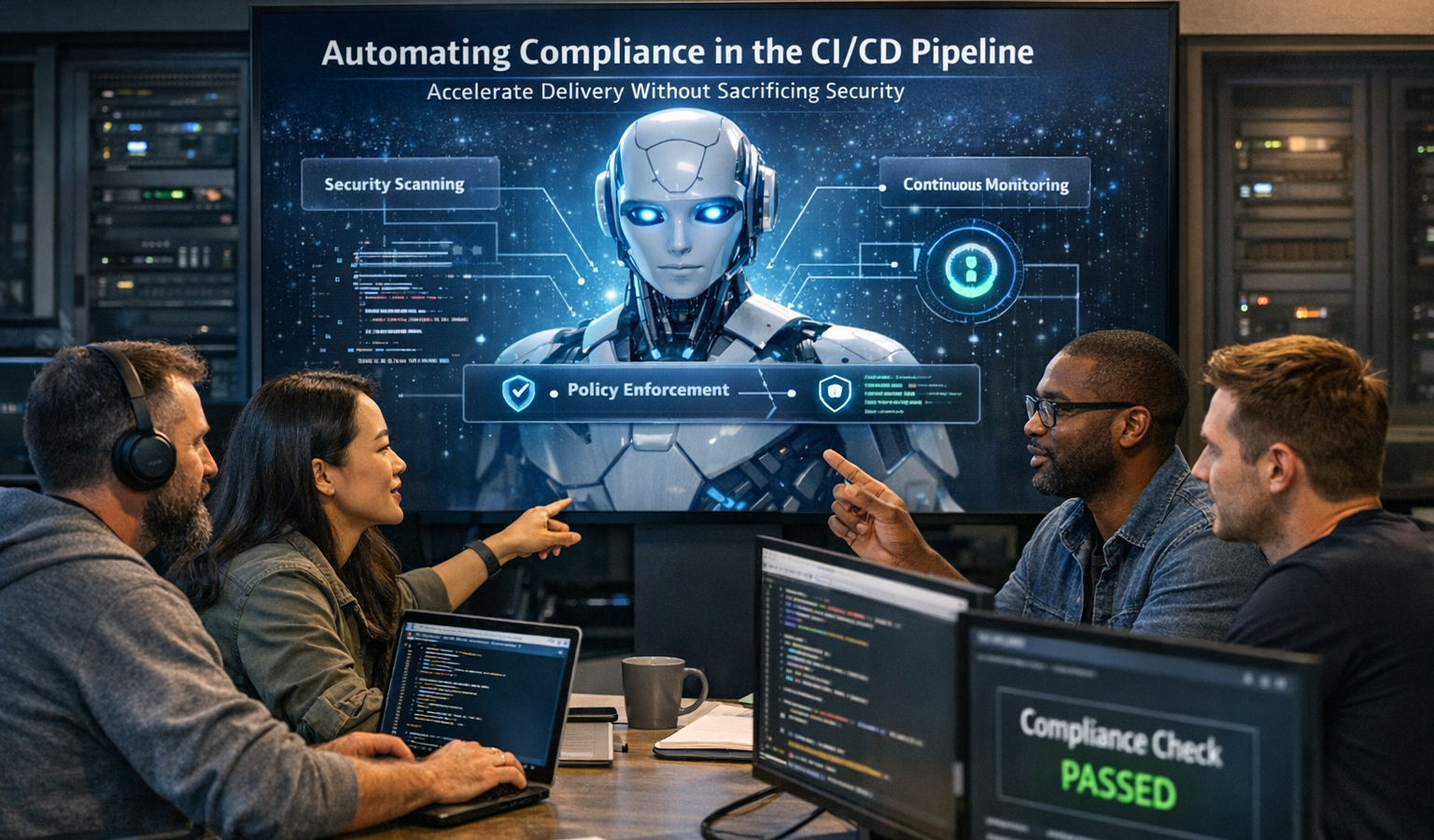
In life, there is always that one guest who shows up late to the party, asks too many questions, and somehow manages to slow everything down. In many software companies, compliance plays that role.
Developers build, test, and deploy at lightning speed. Features move from idea to production in days - or hours. Then, just as everything seems ready, compliance steps in with a clipboard full of requirements, triggering manual audits, rework, and delays. What should have been a smooth release suddenly feels like a bureaucratic obstacle course.
This dynamic is not just frustrating - it is expensive. Manual compliance processes introduce bottlenecks, increase risk, and undermine the very agility that modern DevOps practices aim to achieve.
Forward-thinking organizations are solving this problem by shifting compliance left and embedding it directly into the CI/CD pipeline. The result is a model where security and compliance are not checkpoints at the end, but continuous, automated processes that run alongside development.
The question on everyone’s mind is - How can DevSecOps teams automate compliance within CI/CD pipelines, enabling continuous validation, faster delivery, and stronger security outcomes?
The Problem with Traditional Compliance Models
Manual Audits and Their Hidden Costs
Traditional compliance processes rely heavily on manual reviews, periodic audits, and static documentation. While these approaches may satisfy regulatory requirements on paper, they struggle to keep pace with modern development cycles.
Manual audits introduce several inefficiencies:
- Delayed feedback loops: Issues are discovered late, often after code is production-ready
- Increased rework: Fixing compliance gaps late in the cycle is costly and time-consuming
- Operational bottlenecks: Teams must pause delivery to address audit findings
- Human error risk: Manual checks are inherently inconsistent and prone to oversight
In a CI/CD-driven environment, where code changes frequently and deployments are continuous, these limitations become even more pronounced.
The Mismatch with Modern Development Practices
CI/CD pipelines are designed for speed, automation, and repeatability. Compliance, in its traditional form, is none of these.
This mismatch creates tension between development and governance:
- Developers prioritize speed and innovation
- Compliance teams prioritize risk mitigation and control
Without alignment, organizations face a trade-off between velocity and security - one that is increasingly unacceptable in competitive markets.
What Is Automated Compliance in CI/CD?
Defining Continuous Compliance
Automated compliance in CI/CD refers to embedding compliance controls directly into the development and deployment pipeline. Instead of relying on periodic audits, organizations continuously validate that code, configurations, and infrastructure meet defined standards.
This approach is often referred to as continuous compliance.
Key characteristics include:
- Policy-as-code: Compliance rules are codified and version-controlled
- Automated validation: Checks are executed automatically at each pipeline stage
- Real-time feedback: Developers receive immediate insights into compliance issues
- Audit readiness: Evidence is generated continuously, not retroactively
Why DevSecOps Is Central to the Shift
DevSecOps integrates security and compliance into the DevOps lifecycle. Rather than treating compliance as a separate function, it becomes a shared responsibility across development, security, and operations teams.
This cultural and technical shift enables:
- Early detection of vulnerabilities and compliance gaps
- Reduced friction between teams
- Faster, more reliable software delivery
Core Components of Compliance Automation

Policy-as-Code: The Foundation
At the heart of automated compliance is policy-as-code. This involves translating regulatory and organizational requirements into machine-readable rules.
Examples include:
- Enforcing encryption standards for data in transit and at rest
- Validating access control configurations
- Ensuring infrastructure adheres to security baselines
Policies are stored in version control systems, allowing teams to:
- Track changes over time
- Review and approve updates collaboratively
- Apply policies consistently across environments
Automated Security Testing
Security testing must be integrated into every stage of the CI/CD pipeline.
Static Application Security Testing (SAST)
SAST tools analyze source code for vulnerabilities before it is compiled. This helps identify issues early in the development process.
Dynamic Application Security Testing (DAST)
DAST tools test running applications to uncover runtime vulnerabilities, such as injection attacks or authentication flaws.
Software Composition Analysis (SCA)
SCA tools identify vulnerabilities in third-party dependencies, which are often a major source of risk.
By automating these tests, organizations can enforce compliance requirements without slowing down development.
Infrastructure as Code (IaC) Scanning
Modern applications rely heavily on cloud infrastructure defined through code. Misconfigurations in this layer can lead to significant compliance violations.
IaC scanning tools validate configurations against compliance standards, such as:
- Network security rules
- Identity and access management policies
- Resource provisioning guidelines
This ensures that infrastructure is compliant before it is deployed.
Continuous Monitoring and Logging
Compliance does not end at deployment. Continuous monitoring ensures that systems remain compliant over time.
Key practices include:
- Real-time log analysis
- Automated alerts for policy violations
- Continuous configuration drift detection
These capabilities provide ongoing visibility and enable rapid response to emerging risks.
Building Compliance into the CI/CD Pipeline
Integrating Compliance Checks at Every Stage
To achieve continuous compliance, checks must be embedded throughout the pipeline.
Code Commit Stage
- Run SAST and linting tools
- Enforce secure coding standards
- Validate secrets management practices
Build Stage
- Perform dependency scanning (SCA)
- Validate build configurations
- Generate compliance reports
Test Stage
- Execute DAST and integration tests
- Validate authentication and authorization flows
- Ensure data protection controls are in place
Deployment Stage
- Scan IaC templates
- Validate environment configurations
- Enforce deployment policies
Post-Deployment Stage
- Monitor logs and system behavior
- Detect anomalies and policy violations
- Maintain audit trails
By distributing compliance checks across the pipeline, organizations eliminate the need for a single, disruptive audit phase.
Benefits of Automating Compliance

Accelerated Time to Market
Automated compliance removes bottlenecks, enabling faster releases without compromising security.
Teams can:
- Deploy more frequently
- Reduce time spent on manual reviews
- Respond quickly to market demands
Improved Risk Management
Continuous validation reduces the likelihood of compliance violations and security incidents.
Organizations gain:
- Early detection of vulnerabilities
- Consistent enforcement of policies
- Reduced exposure to regulatory penalties
Enhanced Developer Experience
Developers receive immediate feedback, allowing them to address issues in real time.
This leads to:
- Less rework
- Greater ownership of security and compliance
- Increased productivity
Audit Readiness and Transparency
Automated pipelines generate detailed logs and reports, providing a clear audit trail.
This simplifies:
- Regulatory audits
- Internal reviews
- Compliance reporting
Common Challenges and How to Overcome Them
Cultural Resistance
Shifting to automated compliance requires a cultural change. Teams must embrace shared responsibility for security and compliance.
Solution:
Promote cross-functional collaboration and provide training to align teams around DevSecOps principles.
Toolchain Complexity
Integrating multiple tools into the CI/CD pipeline can be complex.
Solution:
Adopt platforms that support integration and standardization. Focus on interoperability and scalability.
Policy Management
Maintaining and updating policies can be challenging, especially in dynamic regulatory environments.
Solution:
Use version-controlled policy frameworks and establish governance processes for policy updates.
Balancing Speed and Control
Overly strict policies can slow down development, while lenient policies increase risk.
Solution:
Continuously refine policies based on feedback and risk assessments. Aim for a balance that supports both agility and security.
Real-World Example: From Bottleneck to Enabler
Consider a financial services company operating under strict regulatory requirements. Initially, their release process included a manual compliance review that took several days.
By implementing automated compliance in their CI/CD pipeline, they:
- Reduced audit time from days to minutes
- Increased deployment frequency by 3x
- Improved compliance accuracy through consistent policy enforcement
Compliance transformed from a bottleneck into an enabler of faster, safer innovation.
Best Practices for Implementing Automated Compliance
Start with High-Impact Controls
Focus on automating the most critical compliance requirements first. This delivers immediate value and builds momentum.
Standardize Across Environments
Ensure that policies and controls are applied consistently across development, staging, and production environments.
Measure and Iterate
Track key metrics, such as:
- Number of compliance violations detected
- Time to remediate issues
- Deployment frequency
Use these insights to refine your approach.
Foster a DevSecOps Culture
Encourage collaboration between development, security, and operations teams. Shared ownership is essential for success.
Conclusion: Compliance as a Continuous Advantage

Compliance no longer needs to be the late-arriving guest that disrupts the flow of software delivery. By embedding compliance into the CI/CD pipeline, organizations can transform it into a continuous, automated process that supports innovation rather than hindering it.
Automated compliance enables faster delivery, stronger security, and improved audit readiness - all while reducing operational friction. It aligns seamlessly with DevSecOps principles, ensuring that compliance is integrated into every stage of the development lifecycle.
For organizations looking to remain competitive in an increasingly regulated and fast-paced digital landscape, the path forward is clear: treat compliance as code, automate relentlessly, and make continuous validation a core part of the pipeline.
The next step is actionable and immediate - identify one compliance control that is currently manual, and automate it within your CI/CD pipeline. From there, scale systematically. The payoff is not just efficiency, but a fundamentally more resilient and agile software delivery model.
For any questions about automating compliance in software development, please contact us at ScreamingBox.
For more info on some of the topics in this blog, check out our podcast on AI, Security & Software Governance